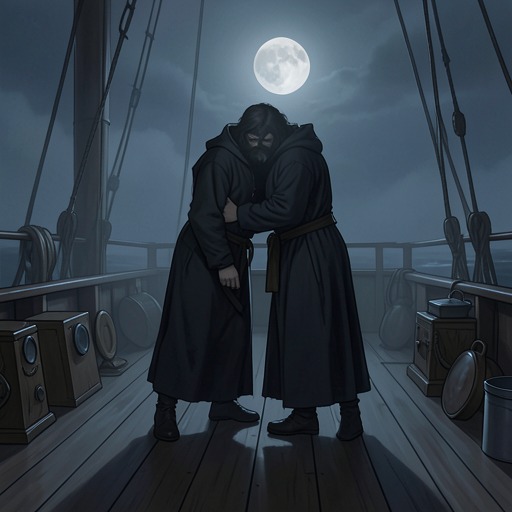
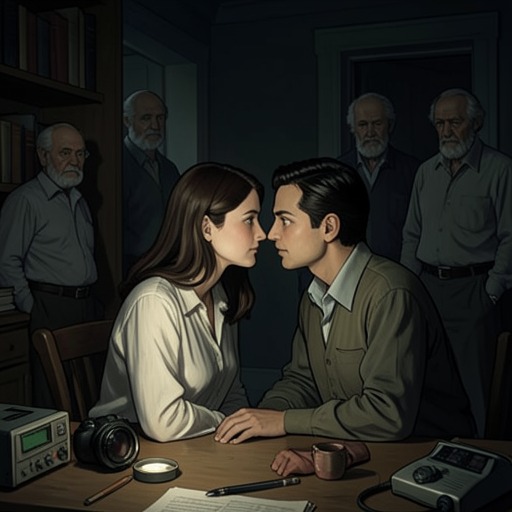
Tristan and Isolde’s encounter aboard ship
Finnegans WakeTristan and Isolde’s encounter aboard ship is rendered as an intimate embrace overheard and repeatedly remembered by the Four Old Men. The scene moves from a lover’s kiss to a chorus of birds and listening witnesses, making private desire at once a physical episode, a scandal, and a story that communal memory keeps revising.
The Encounter and Its Witnesses
The lovers are pictured on a small loveseat behind the stewardesses’ cabin, where Tristan cuddles and kisses Isolde, dressed in maiden blue with a net overdress touched with gold. The narration dwells on his hands moving over her clothing and on their kissing; it presents the encounter as plainly improper, not as a decorous courtship. Their closeness is framed by the ship and its cabin, but the scene does not remain private.
Seahawks, seagulls, curlews, plovers, kestrels, and other sea birds sing out as the lovers kiss. The birds’ song enlarges the moment into a spectacle carried across the surrounding sea, while the four old listeners hear the intimacy from afar. The contrast between the enclosed loveseat and the open, listening world turns the encounter into something exposed even as it remains hidden from the lovers themselves.
The Four Old Men’s Recollection
The witnesses are Matt Gregory, Marcus Lyons, Luke Tarpey, and Johnny MacDougall, identified together as the Four Old Men and as the four master waves of Erin. Their collective identity emerges through a remembered grace before fish: each man is named, the company insists that there are four and no more, and the ritual of passing the fish returns in their account. Their listening to Tristan and Isolde is therefore bound to a voice already shaped by repetition and fellowship.
Their recollection folds the shipboard encounter into earlier scenes of youthful life. They remember themselves as collegians near O’Clery’s, with slates and satchels, playing, drinking, and raising hell; they also recall an oyster supper at Cullen’s barn and the old dramatic world associated with Dion Boucicault. These memories do not establish a single, stable chronology for the lovers’ scene. Instead, the telling lets the old men’s past and the lovers’ present mingle, so that recollection itself becomes part of the event’s continuing life.
Desire, Scandal, and Retelling
The narration repeatedly marks the intimacy as shocking and scandalous, even as it luxuriates in its lyrical surroundings: the birds, the fair night, the shining stars, and the moonlight. The old men listen with eyes glistening and mouths watering, and their attention makes desire a shared, bodily response as well as an object of moral judgment. Their remembered language of youthful mischief and sexual transgression gives the scene a double charge: it is at once a lovers’ encounter and a return to the listeners’ own unruly past.
The episode belongs to the book’s wider traffic in rumor and public narration. Elsewhere, HCE’s encounter with a cad unfolds through an awkward exchange about the time and a defensive account of an accusation; Hosty’s ballad turns disputed reputation into a communal performance, with a refrain assigning him the task of making the rhyme. Against that background, Tristan and Isolde’s intimacy likewise arrives through witnesses and retelling rather than through an isolated, authoritative account. The Four Old Men’s listening does not resolve what the encounter means; it ensures that the private scene survives as a shared, changeable story.